
Call us now :08045477157
 Send Inquiry
 Send Inquiry
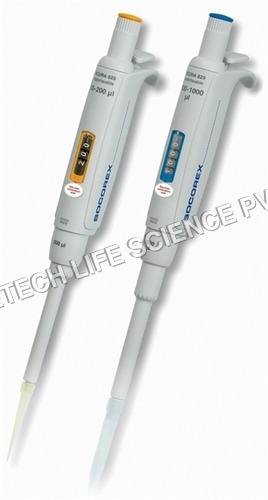
Micro Pipettes
MOQ : 1 Box
Micro Pipettes Specification
- Temperature Resistance
- Ambient Laboratory Temperatures
- Shape
- Pen-Shaped
- Accuracy
- 1.5%
- Display Type
- Digital or Analog Volume Display
- Speed Range
- Manual Control
- Features
- Ergonomic design, easy calibration, autoclavable tip cone
- Control Type
- Plunger Button Controlled
- Type
- Variable Volume Micro Pipette
- Dimension (L*W*H)
- Approx. 200 mm x 30 mm x 20 mm
- Equipment Type
- Single Channel or Multi Channel Micro Pipette
- Equipment Materials
- Plastic & Metal components
- Power
- Manual (No power required)
- Material
- High-grade Polypropylene (PP)
- Application
- Precise liquid handling in laboratories
- Capacity (Ltr)
- 0.00001 - 0.01 L (10 l 10 ml)
- Autoclavable Parts
- Lower part (tip cone and ejector) autoclavable at 121C
- Tip Ejector
- Yes, in-built
- Volume Range
- 0.5 l to 10,000 l (model dependent)
- Color Code
- Model specific for easy identification
- Calibration
- Factory calibrated, user recalibration possible
- Increment
- Variable, as fine as 0.1 l
- Chemical Resistance
- Resistant to commonly used laboratory chemicals
- Orifice Size
- Model dependent
- Piston Material
- Stainless Steel
- Usage Environment
- Molecular Biology, Diagnostic Labs, Research Institutions
- Compliance
- ISO 8655 standard
- Weight
- Approx. 90 110g
Micro Pipettes Trade Information
- Minimum Order Quantity
- 1 Box
- Supply Ability
- 20 Boxes Per Day
- Delivery Time
- 4-6 Week
- Sample Available
- No
- Main Domestic Market
- Haryana, Himachal Pradesh, Rajasthan, Uttarakhand, Chandigarh, Punjab, Delhi, Uttar Pradesh
About Micro Pipettes
Micro Pipettes are the most important instruments of pathological & microbiological laboratories, hospitals, research centers, and clinics. They are required for precise measurement & dispensing of samples & reagents in very small volumes while performing various biochemical tests. These are handheld pipettes that are very easy to operate and assure complete reliability & excellent repeatability. They are provided with a trigger for automatic removal of tip hence eliminates chances of contamination & infection. Micro Pipettes gives flexibility of adjusting pipetting volume from a specified range with ease. They comprise plunger button, plunger rod, micrometer, and piston assembly. These pipettes are light in weight and assure long service life.
Precision Liquid Handling for Laboratory Applications
Engineered for accuracy, these micro pipettes deliver reliable volume adjustments from 0.5 l to 10,000 l, making them ideal for a diverse range of laboratory tasks. With a fine increment control down to 0.1 l and ergonomic design, users can dispense precise quantities comfortably and efficiently, reducing hand fatigue during extended usage.
Autoclavable and Durable Components
The lower part, including the tip cone and ejector, is autoclavable at 121C, ensuring safe sterilization and contamination-free operations in sensitive environments. Constructed from high-grade polypropylene and stainless steel, these pipettes offer robust chemical resistance and long-lasting performance in molecular biology, diagnostics, and research laboratories.
Easy Calibration and Compliance
Meeting ISO 8655 standards, these micro pipettes are factory-calibrated for immediate use but also support convenient user recalibration. The process is straightforward, ensuring continued accuracy and reliability. Distinct color coding simplifies model identification, while digital or analog displays promote clear volume readings.
FAQs of Micro Pipettes:
Q: How do I recalibrate the micro pipette if accuracy seems off?
A: If recalibration is needed, consult the user manual for your models specific recalibration process, usually involving simple adjustment tools. The pipettes design enables easy user recalibration to maintain its 1.5% accuracy, even after extensive use.Q: What is the benefit of having an autoclavable lower part on the pipette?
A: The autoclavable tip cone and ejector allow for reliable sterilization at 121C, reducing the risk of cross-contamination and ensuring safe usage, especially in molecular biology and diagnostic applications where purity is crucial.Q: Where can these micro pipettes be used effectively?
A: These micro pipettes are ideally suited for molecular biology, diagnostic laboratories, research institutions, and any environment requiring precise and repeatable liquid handling. Their chemical resistance and robust build make them well-adapted for these demanding settings.Q: When should I use the tip ejector feature?
A: The in-built tip ejector should be used after each aspiration or dispensing to safely and efficiently dispose of used tips, minimizing contact with potentially hazardous materials and maintaining workflow hygiene.Q: What is involved in the process of sterilizing the pipettes autoclavable parts?
A: Remove the lower part (tip cone and ejector) as per instructions and place it in an autoclave at 121C for the recommended time. Once cooled, reassemble the pipette for reuse. This ensures sterility without compromising component integrity.Q: How does the model-specific color coding benefit laboratory workflow?
A: Color coding enables easy and quick identification of pipette models, preventing cross-use and helping streamline workflow selection, especially in settings handling different volume requirements or multi-channel instruments.Q: What advantage does manual control offer for volume and speed dispensing?
A: Manual control via the plunger button gives the user direct, tactile feedback, enabling precise control of both the dispensed volume and speed. This ensures accuracy and versatility in various experimental protocols.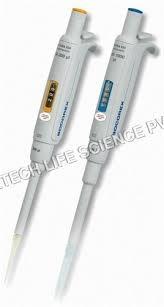
Tell us about your requirement

Price:
Quantity
Select Unit
- 50
- 100
- 200
- 250
- 500
- 1000+
Additional detail
Mobile number
Email

More Products in SOCOREX Precision Liquid Volumetry Category
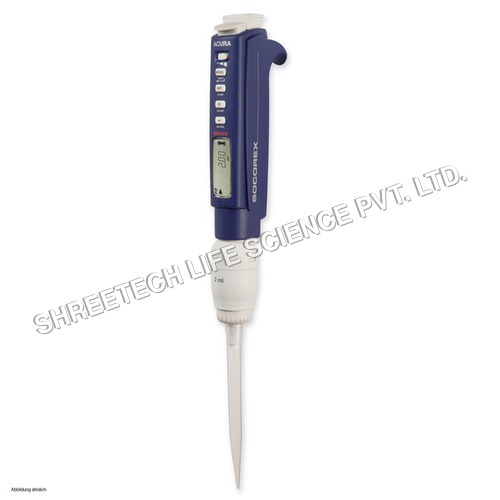
Macro Electronic Micropipettes
Minimum Order Quantity : 1 Box
Capacity (Ltr) : Variable volume: 10 L to 1000 L (model dependent)
Type : Other, Electronic Micropipette
Application : Precise liquid handling in laboratories, research, biotechnology, medical, and industrial applications
Material : Robust plastic body with soft grip handle
Equipment Materials : Highgrade plastic, corrosionresistant internal components
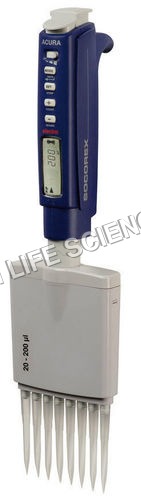
Multi Electronic Micropipettes
Minimum Order Quantity : 1 Box
Capacity (Ltr) : 10 L 1000 L
Type : Other, Multi Electronic Micropipette
Application : Liquid handling in molecular biology, chemistry laboratories, clinical tests
Material : ABS Plastic and Stainless Steel
Equipment Materials : Premium quality ABS plastic, stainless steel mechanisms
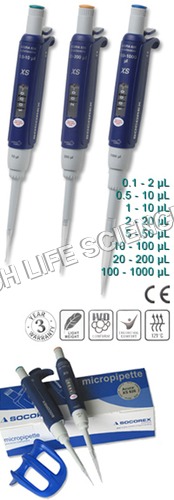
Extra Sharp DIGITAL READING MICROPIPETTES
Minimum Order Quantity : 1 Box
Capacity (Ltr) : Variable, based on model (e.g., 0.1 L to 10 L, 10 L to 100 L, 100 L to 1000 L)
Type : Other, Digital Reading Micropipette
Application : Precise liquid handling in laboratories
Material : Durable autoclavable plastic
Equipment Materials : Highgrade plastic and metal parts
Micro Digital Reading Micropipettes
Minimum Order Quantity : 1 Box
Capacity (Ltr) : Variable, typically 0.5 to 10 L / 2 to 20 L / 10 to 100 L
Type : Other, Micro Digital Reading Micropipettes
Application : Laboratory liquid handling, chemical analysis, biological research
Material : Polypropylene (PP)
Equipment Materials : Plastic, Highgrade polymers


 Send Inquiry

Our Products
- Lovibond Colour Measurement Instruments
- Lovibond Water Testing Equipments
- Water Purification Systems
- SOCOREX Precision Liquid Volumetry
- Laboratory Viscometers
- Rheometers
- BLUESEN SMART WATER ANALYZERS
- Testing and Measuring Equipment
- Online Turbidity Meter
- Electrical Testing and Measuring Equipment
- Multifunction Meter
- Measuring tools and Equipment
- Digital Sensor

Plot No. 6, Club Drive, M.G. Road, GhitorniNew Delhi - 110030, India

Mr Sumit Bhatia
(Director)
Mobile :08045477157
 Send Inquiry
 Send SMS
Developed and Managed by Infocom Network Private Limited.
 English
 Spanish
 French
 German
 Italian
 Chinese (Simplified)
 Japanese
 Korean
 Arabic
 Portuguese